
R134a Cans vs 30 lb Cylinders: Which Buying Path Fits?
A buyer-focused guide to choosing between R134a small cans and a 30 lb cylinder, including MVAC use, Section 608/609 context, package size, records, receiving, and storage checks.
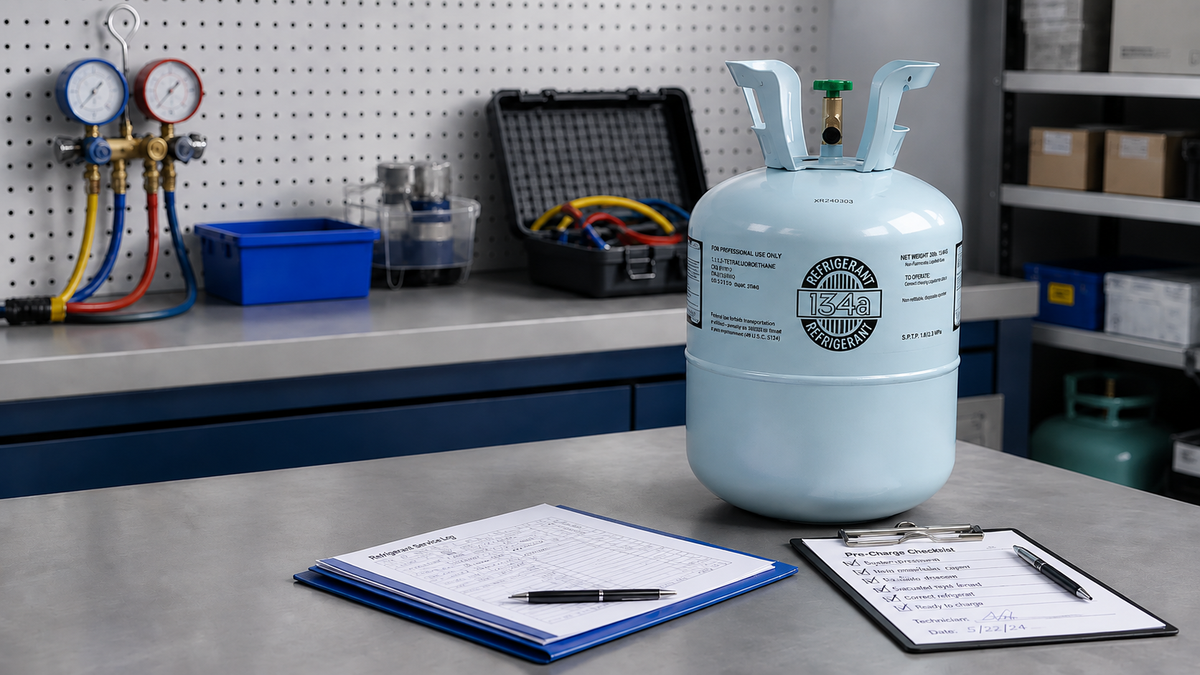
If you are comparing R134a small cans with a 30 lb cylinder, the right choice is not just a price-per-ounce calculation. The package size changes the buyer, the documentation, the service workflow, the storage plan, and sometimes the certification path. A small can may fit an individual motor-vehicle A/C top-off context, while a 30 lb cylinder is a shop or qualified-buyer purchase that should be tied to repeat service work, proper equipment, and clear records.
For current package and checkout details, use the live 30 lb R134A refrigerant product page. Use this guide to decide whether that package size fits the job before you treat a large cylinder and a retail can as interchangeable buying options.
The short answer
Choose the 30 lb cylinder only when the buyer has a documented need for R134a across multiple compatible jobs, can meet the seller's purchase requirements, has the right service equipment, and can store and track the cylinder responsibly. A small can is a different retail format, normally aimed at limited motor-vehicle A/C use. It should not be used as a shortcut for shop inventory planning, stationary HVAC service, or systems that require another refrigerant such as R1234yf.
EPA's refrigerant sales restriction explains that sales generally cover refrigerants in cylinders, cans, or drums, with a limited small-can exception for substitute MVAC refrigerants. EPA states that small cans of non-exempt MVAC refrigerant designed to hold two pounds or less can be sold without certification for DIY vehicle use when they have unique fittings and self-sealing valves. A 30 lb cylinder does not fit that exception.
Why package size changes the compliance question
R134a is commonly associated with motor-vehicle air conditioning, but the intended use still matters. EPA separates Section 608 stationary refrigeration and air-conditioning work from Section 609 motor-vehicle air-conditioning work. A Section 609-certified technician may purchase refrigerant found acceptable for MVAC use, while Section 608 certification applies to stationary equipment purchases. EPA also says Section 609 certification does not authorize purchase of refrigerant intended for stationary equipment, regardless of container size.
That distinction matters when a buyer searches for "R134a cylinder," "AutoZone R134a," "30 lb R134a," or "a can of Freon" as if those terms describe the same transaction. They do not. The seller, purchaser, invoice, certification evidence, and intended appliance category should all line up before a large cylinder ships.
Small cans and 30 lb cylinders are built for different workflows
| Buying question | Small R134a can | 30 lb R134a cylinder |
|---|---|---|
| Typical use case | Limited MVAC retail or DIY vehicle service context | Professional or qualified-buyer inventory for repeated R134a jobs |
| Package check | Confirm net contents, self-sealing valve, and correct MVAC fittings | Confirm refrigerant designation, 30 lb net contents, cylinder condition, and order records |
| Buyer documentation | Small-can exception may apply only when EPA conditions are met | Expect seller verification and invoice recordkeeping for larger regulated purchases |
| Best buyer | Someone with a vehicle-specific, small-quantity need | Auto A/C shops, fleet service teams, and qualified repeat buyers |
| Main risk | Using the wrong product, relying on pressure alone, or topping off a leaking system | Buying more inventory than the shop can use, store, document, or legally purchase |
When a 30 lb R134a cylinder makes sense
A larger cylinder can make practical sense for a repair shop, fleet maintenance team, or purchasing department that services multiple R134a vehicles or approved refrigeration applications and already has a process for refrigerant handling. The buyer should be able to identify the vehicles or jobs, the technician responsible for service, the required refrigerant, and the storage location before ordering.
Use the existing R134A 30 lb pre-purchase checklist when the decision has moved from "Which package type?" to "How do I verify this specific cylinder order?" That checklist covers net weight, product condition, shipping, receiving, SDS access, and seller questions in more detail.
A 30 lb cylinder is usually a poor fit when the buyer needs one small vehicle top-off, has no recovery or service equipment, cannot confirm the vehicle label, or is trying to use R134a in a system labeled for R1234yf. The larger package can look cheaper by unit weight while still being the wrong operational choice.
Do not use package size to approve compatibility
R134a and R1234yf are different refrigerants. A vehicle label, service information, and MVAC equipment should determine which product belongs in the system. EPA's unique-fitting rules for MVAC refrigerants are designed to reduce accidental mixing and cross-contamination, and EPA says an adapter may not be used to convert a fitting. If the car or service equipment points to R1234yf, a lower R134a cylinder price is not a buying argument.
If the refrigerant identity is still unclear, use the published guide R134a vs R1234yf and then verify the vehicle label or manufacturer service information. The broader automotive refrigerant collection is useful for catalog browsing, but it is not compatibility approval.
Records, receiving, and storage for larger purchases
EPA's seller guidance says refrigerant vendors must retain invoices showing purchaser name, sale date, and quantity, and online sales are subject to the same verification and recordkeeping framework as in-person sales. Buyers should expect that process rather than treating it as unusual friction.
When a 30 lb cylinder arrives, compare the delivered item with the order confirmation before it enters inventory. Check the product label, net contents, valve protection, visible damage, carton condition, and documentation. Do not connect a cylinder that appears damaged, leaking, mislabeled, or inconsistent with the order.
Store accepted cylinders in a controlled area according to the label, SDS, workplace policy, carrier instructions, and local requirements. Keep the cylinder secured from falling, protected from heat and physical damage, and restricted from unauthorized handling. The larger the package, the more important it is to assign responsibility for inventory, not just receiving.
A practical decision checklist
- Vehicle or equipment confirmed: The label or service documentation specifies R134a.
- Use category confirmed: The buyer knows whether the refrigerant is for MVAC or stationary equipment.
- Package size justified: A 30 lb cylinder matches repeated service demand, not a single uncertain top-off.
- Certification path understood: The buyer can satisfy the seller's verification process for the intended use.
- Service equipment ready: The shop has appropriate recovery, recycling, charging, weighing, and leak-diagnosis tools.
- Receiving process ready: Someone will inspect the shipment, save documents, and report damage quickly.
- Storage assigned: The cylinder has a secure, suitable storage location before delivery.
FAQ
Is a 30 lb R134a cylinder cheaper than small cans?
It can have a lower unit cost for qualified repeat buyers, but price is not enough. Compare net refrigerant weight, certification requirements, service equipment, delivery terms, storage, and whether the shop can use the quantity before it becomes idle inventory.
Can anyone buy a 30 lb R134a cylinder?
No general "anyone can buy" answer is appropriate. EPA sales restrictions and seller verification depend on the refrigerant, package, certification, and intended use. A 30 lb cylinder is not the small-can MVAC exception.
Are small R134a cans exempt from all rules?
No. EPA's small-can exception is limited to qualifying MVAC substitute refrigerant containers designed to hold two pounds or less and equipped with unique fittings and self-sealing valves. Service work and vehicle compatibility still matter.
Can R134a be used in an R1234yf vehicle?
Do not assume that. Use the refrigerant specified by the vehicle label and service information. EPA requires unique fittings for MVAC refrigerants to help prevent mixing, and adapters should not be used to force a mismatch.
Who is the best buyer for a 30 lb R134a cylinder?
A shop, fleet team, or qualified purchaser with repeated R134a service needs, proper MVAC equipment, purchase documentation, and secure storage is a better fit than a one-time buyer trying to solve an uncertain A/C problem.
Final check before ordering
Treat R134a cans and 30 lb cylinders as different buying paths. Confirm the vehicle or equipment label, the intended use, the certification requirement, the package size, and the shop workflow before comparing price. If a large cylinder fits the documented need, use the live product page for current details and keep the purchase, receiving, and service records together.
Authoritative references: EPA refrigerant sales restriction, EPA sales restriction Q&A, and EPA MVAC unique fittings and label colors.
