
Can You Use R32 in an R410A System?
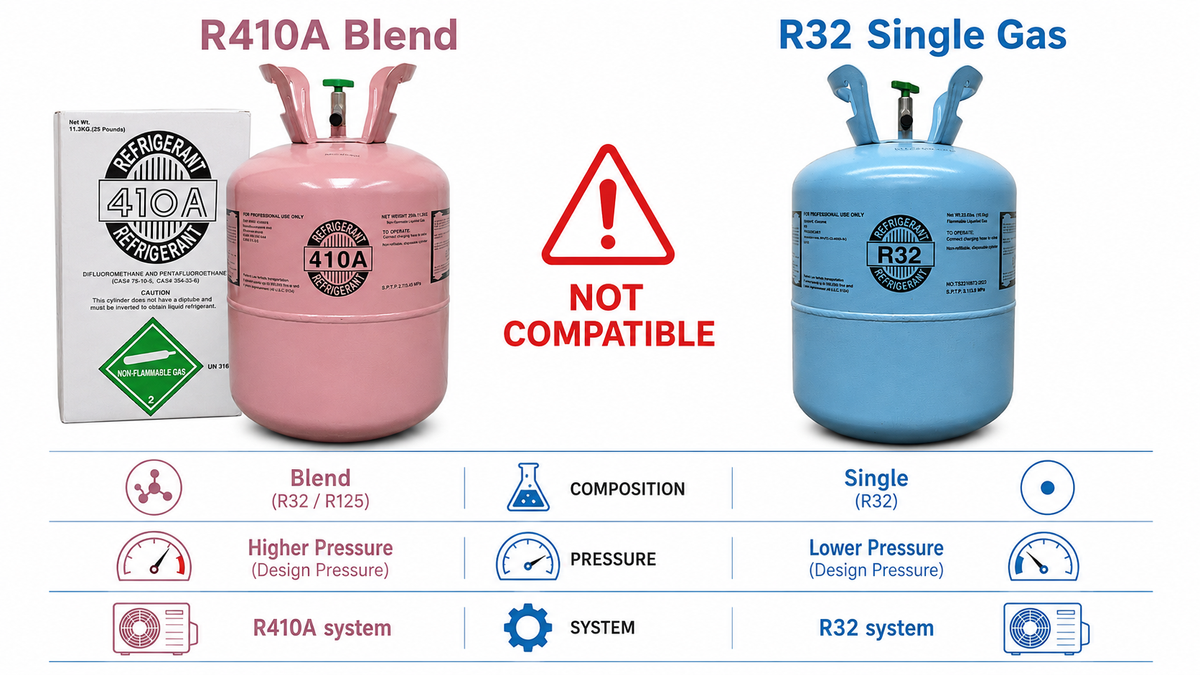
No. R32 should not be used to charge or top off an R410A system unless the equipment manufacturer has issued explicit, model-specific conversion instructions.
Although R32 is one component of R410A, pure R32 and R410A are not interchangeable. Mixing them changes the refrigerant composition and can create performance, reliability, compliance, and safety problems.
Why R32 Is Not a Drop-In Replacement
A drop-in replacement would need to work within the original system’s approved operating limits without major modification or new safety controls.
R32 does not meet that description for a typical R410A system.
R32 differs from R410A in:
- Refrigerant composition
- Safety classification
- Pressure-temperature behavior
- Mass-flow characteristics
- Required charge
- Equipment approvals
- Installation requirements
- Service procedures
- Potential risk controls
An R410A unit was not automatically evaluated, labeled, or listed for operation with an A2L refrigerant.
“R410A Contains R32” Does Not Make Them Interchangeable
R410A contains R32 and R125 in a defined composition. The finished blend has characteristics different from either component used alone.
Adding pure R32 changes that balance. The resulting refrigerant is no longer correctly formulated R410A, nor is the original equipment necessarily suitable for pure R32.
This is similar to the difference between a finished engineered fluid and one of its ingredients. The presence of an ingredient does not make the ingredient an approved replacement for the completed formulation.
What Could Happen If R32 Is Added?
Possible consequences include:
- Incorrect operating pressures
- Unstable superheat or subcooling readings
- Reduced capacity
- Higher compressor stress
- Unexpected discharge temperatures
- Incorrect refrigerant charge
- Expansion-device mismatch
- Changed flammability characteristics
- Loss of equipment listing or approval
- Warranty problems
- Unsafe future service conditions
A mixed system can also put the next technician at risk if the actual contents are unknown or mislabeled.
Can R32 Be Used to Top Off R410A?
No. Do not use R32 to top off an R410A charge.
When an R410A system is low, a qualified technician should:
- Confirm that the system actually has a low charge.
- Locate and assess the leak.
- Follow applicable repair and recovery requirements.
- Recover refrigerant when necessary.
- Repair and test the system.
- Recharge with the manufacturer-specified refrigerant and quantity.
- Label and document the work appropriately.
Adding a different refrigerant does not fix the underlying leak.
Can an R410A System Be Converted to R32?
A conversion should not be attempted unless the original equipment manufacturer provides a documented, model-specific procedure.
A safe conversion could require much more than removing one refrigerant and adding another. Relevant considerations could include:
- Compressor approval
- Electrical components
- Expansion device
- Refrigerant piping
- Charge limits
- Room-volume calculations
- Leak mitigation
- Ventilation
- Controls and sensors
- Product listing
- Building and fire codes
- Updated labels
- Technician qualifications
Without manufacturer authorization, replacing the complete system with equipment designed for R32 is generally more defensible than attempting an improvised field conversion.
How to Identify the Correct Refrigerant
Look for the equipment nameplate on the outdoor unit. It commonly identifies:
- Refrigerant designation
- Factory charge
- Additional charge information
- Electrical ratings
- Model and serial number
- Design pressures
The service manual may also specify:
- Approved refrigerant
- Charging method
- Required tools
- Piping limitations
- Oil information
- Leak-test procedure
- Safety precautions
Do not rely only on cylinder color. Cylinder colors and packaging practices can vary.
What If the Nameplate Is Missing?
Do not guess.
Record the manufacturer, model number, serial number, compressor information, and any available service history. A qualified technician or the manufacturer’s technical-support department may be able to identify the correct refrigerant.
If the system’s refrigerant cannot be confirmed, the contents may need to be recovered and handled as potentially mixed or contaminated refrigerant.
What If R32 Was Already Added Accidentally?
Stop operating and servicing the system until a qualified HVAC professional evaluates it.
Tell the technician exactly:
- What product was added
- How much may have been added
- When it was added
- Whether the system operated afterward
- What refrigerant was believed to be present
- Whether any cylinder or purchase documentation is available
Do not vent the contents. The refrigerant should be recovered using appropriate equipment and handled according to applicable requirements.
Buying the Correct Product
Before ordering refrigerant, collect:
- A photo of the unit nameplate
- Manufacturer and model number
- Refrigerant designation
- Required amount
- Technician confirmation
- Shipping address and storage plan
For a confirmed R32 system, review the R32 product description and cylinder details before ordering.
Shop: Buy R32 Refrigerant
For an R410A system, use only manufacturer-specified R410A.
Shop: Buy R410A Refrigerant
Frequently Asked Questions
Can R32 and R410A use the same compressor?
No—at least not in standard field practice.
R32 and R410A systems are engineered differently, even if some compressor families look physically similar. Compressor “appearance compatibility” is not a valid engineering indicator.
Key differences that affect compressor compatibility include:
- Operating pressures and pressure ratios (R32 typically runs differently from R410A)
- Mass flow characteristics
- Discharge temperature behavior
- Lubricant compatibility requirements
- Motor loading and thermal design assumptions
- System protection logic (sensors, inverters, controls)
Even if a compressor can physically move refrigerant, it does not mean it is approved for long-term operation with a different refrigerant.
Only compressors and full systems explicitly rated and documented by the manufacturer for R32 or R410A should be used with those refrigerants.
Can I remove R410A and refill the unit with R32?
Not without a manufacturer-approved conversion procedure.
In practical HVAC service terms, this is not considered a standard service operation—it is a system redesign scenario, not a refrigerant “swap.”
To safely convert a system from R410A to R32 (when even allowed), the manufacturer would need to explicitly define:
- Approved refrigerant change (most R410A systems do not support this)
- Compressor suitability confirmation
- Expansion device compatibility (TXV/EEV or fixed orifice)
- Electrical and control system verification
- Heat exchanger and pressure rating validation
- Safety compliance for A2L refrigerant use (R32 is mildly flammable)
- Required oil type and system cleanliness requirements
- Charge calculation method and limits
- Labeling and code compliance updates
Without these written approvals, changing refrigerants can lead to:
- Unsafe operating conditions
- Incorrect pressure/temperature behavior
- Equipment damage or premature compressor failure
- Loss of system certification and warranty
- Non-compliance with installation codes and safety standards
In most real-world cases, if R32 is required, the correct solution is a system designed for R32 from the factory, not a retrofit.
Will R32 cool better in an R410A unit?
There is no safe or valid technical basis for that assumption.
Cooling performance is not determined by refrigerant alone. HVAC systems are engineered as a matched system of:
- Compressor
- Expansion device
- Heat exchangers
- Controls and sensors
- Refrigerant type and charge specification
An R410A system is specifically designed around R410A’s thermodynamic properties. Changing refrigerant changes:
- Pressure levels
- Heat transfer behavior
- Mass flow rate
- Compressor operating envelope
- Superheat and subcooling targets
Even if cooling temporarily appears different, it does not mean improved performance. In most cases, it leads to:
- Unstable operation
- Reduced efficiency
- Potential compressor stress
- System control errors
Correct performance comes from using the refrigerant the system was designed and tested for.
Is mixing R32 and R410A dangerous?
Yes. It is not considered a safe or acceptable HVAC practice.
Mixing refrigerants creates an unknown refrigerant blend, which has no defined operating envelope or certified safety characteristics.
Potential issues include:
- Unpredictable pressure–temperature relationship
- Unstable system performance
- Incorrect readings during diagnostics
- Compressor overload or overheating
- Expansion device mismatch
- Altered or unknown flammability behavior (R32 is A2L)
- Contamination of recovery equipment and cylinders
- Difficulty identifying refrigerant during future service
From a service standpoint, a mixed system must be treated as contaminated refrigerant, and should only be handled by qualified HVAC professionals using proper recovery and reclamation procedures.
Can refrigerant be identified by pressure alone?
No. Pressure is not a reliable method of refrigerant identification.
System pressure is influenced by multiple variables, including:
- Refrigerant type (R32, R410A, etc.)
- Ambient temperature
- Indoor load conditions
- Compressor operation state
- System contamination or mixture
- Airflow and heat exchange efficiency
- Expansion device behavior
Two different refrigerants can show overlapping pressure ranges depending on conditions, which makes pressure readings insufficient for identification.
Proper identification methods include:
- Equipment nameplate verification
- Service manual confirmation
- Recovery and controlled analysis (when necessary)
- Certified refrigerant identification tools
In professional HVAC practice, nameplate + documentation always overrides pressure readings.
Should I buy R32 because it is used in newer systems?
Only if your equipment specifically requires it.
R32 is being used in some newer HVAC systems, but that does not make it a universal upgrade or replacement option.
Before purchasing, confirm:
- The equipment is explicitly designed for R32
- The model number matches manufacturer documentation
- The system is rated for A2L refrigerants
- A qualified HVAC technician is handling installation or service
Newer refrigerants are not “better by default”—they are system-specific design choices made by manufacturers based on efficiency goals, safety design, and regulatory direction.
For existing systems (especially R410A systems), continuing to use the specified refrigerant is the correct and expected approach unless a manufacturer-approved conversion exists.
Conclusion
R32 is not a drop-in replacement, retrofit shortcut, or top-off product for an R410A system.
Confirm the refrigerant from the equipment documentation and have a properly trained HVAC professional diagnose leaks, recover refrigerant, and charge the system.
Related R32 Guides
If you're dealing with system compatibility or troubleshooting refrigerant issues, these guides will help:
-
R32 vs R410A Comparison
Full breakdown of differences in safety, pressure, and system design.
-
What Is R32 Refrigerant?
Understand what R32 is and where it is properly used.
-
R32 Refrigerant Buying Guide
Make sure you're selecting the correct refrigerant for your system.
-
How to Store R32 Refrigerant Safely
Safety guidelines for handling and storage of R32 cylinders.
