
What Is R32 Refrigerant? Uses, Safety and HVAC Applications
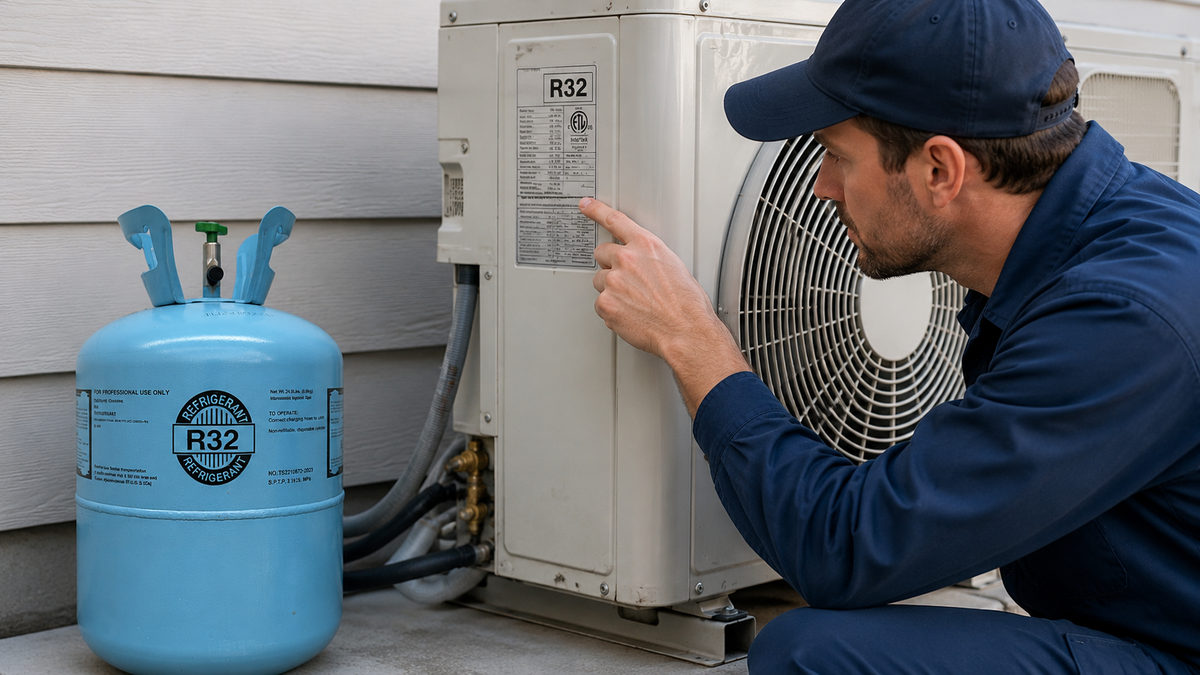
R32 is the refrigerant designation for difluoromethane, an HFC refrigerant used in certain air conditioners, heat pumps, and other cooling equipment specifically designed for it. It is increasingly found in newer HVAC systems as manufacturers move toward refrigerants with lower global-warming impact than several previously common options.
R32 is not a universal replacement refrigerant. It should only be used in equipment whose manufacturer identifies R32 as an approved refrigerant. Refrigerant charging, recovery, leak repair, installation, and conversion work should be performed by properly trained HVAC professionals using equipment and procedures suitable for R32 and A2L refrigerants.
What Does R32 Mean?
“R32” is the standardized refrigerant number assigned to difluoromethane. Its chemical formula is CH₂F₂.
R32 is a single-component refrigerant rather than a blend. That distinction can simplify certain handling characteristics, but it does not make the refrigerant interchangeable with other products.
For example, R410A contains R32 as one of its components, but pure R32 and R410A are different refrigerants. They have different approved applications, charge specifications, performance characteristics, safety considerations, and equipment requirements.
Where Is R32 Refrigerant Used?
R32 can be used in selected new equipment, including certain:
- Residential split-system air conditioners
- Ductless mini-split systems
- Heat pumps
- Packaged air-conditioning equipment
- Light-commercial HVAC systems
- Other manufacturer-approved cooling products
The exact application depends on the equipment design and the conditions under which the refrigerant is permitted.
Never select a refrigerant based only on the appearance or general type of the unit. Confirm the required refrigerant by checking:
- The outdoor unit nameplate
- The installation manual
- The service manual
- The manufacturer’s technical documentation
- Any applicable replacement-component instructions
Is R32 a New Refrigerant?
R32 itself is not newly invented. It has been used internationally for years and has also been used as a component of refrigerant blends, including R410A.
What is changing is its visibility in the U.S. HVAC market. New equipment standards, refrigerant-transition policies, updated safety standards, and manufacturer product development have increased the number of R32 systems available to U.S. customers.
This does not mean every new system uses R32. Manufacturers may use different lower-GWP refrigerants depending on the product category, design, capacity, and applicable regulations.
Is R32 an A2L Refrigerant?
Yes. Under the ASHRAE safety-classification system, R32 is classified as A2L.
The classification can be understood in two parts:
- “A” indicates lower toxicity under the classification criteria.
- “2L” indicates lower burning velocity and mild flammability.
“Mildly flammable” does not mean nonflammable. R32 must be handled with the controls required for an A2L refrigerant.
These controls may include:
- Preventing ignition sources in the work area
- Providing appropriate ventilation
- Using approved leak-detection methods
- Observing equipment charge limits
- Following manufacturer-prescribed installation clearances
- Using service tools rated or approved for the application
- Following applicable mechanical, fire, electrical, and building codes
Does R32 Damage the Ozone Layer?
R32 has zero ozone-depletion potential because it does not contain chlorine.
That does not mean it has no environmental impact. R32 is still an HFC and contributes to global warming if released into the atmosphere. Technicians should recover refrigerant rather than intentionally venting it.
Refrigerant comparisons should consider more than one environmental number. System efficiency, leakage, charge size, equipment life, recovery practices, and end-of-life management can all affect the overall impact.
How Is R32 Different From R410A?
R32 and R410A are related, but they are not the same product.
| Characteristic | R32 | R410A |
|---|---|---|
| Composition | Single-component refrigerant | Refrigerant blend |
| Safety classification | A2L | A1 |
| Flammability classification | Mildly flammable | No flame propagation under classification tests |
| Common use | Selected newer systems designed for R32 | Many existing residential and light-commercial systems |
| Interchangeable? | No | No |
| Equipment requirement | R32-approved equipment | R410A-approved equipment |
A system designed for R410A should not be charged with R32 unless the equipment manufacturer has issued explicit conversion instructions and all technical, safety, and code requirements are satisfied.
For a more detailed comparison, read our guide to R32 versus R410A.
R32 vs. R410A: Differences in Safety, Use and Compatibility
Is R32 Better Than R410A?
“Better” depends on the equipment and the purpose of the comparison.
R32 can offer advantages in systems engineered around its properties. It has a lower global warming potential than R410A and is used by manufacturers in newer equipment designs.
However, choosing between R32 and R410A is not like choosing between two brands of the same replacement part. The refrigerant is part of the entire engineered system.
A well-installed R410A system should continue to use the refrigerant specified by its manufacturer. An R32 system must be installed and serviced according to its R32-specific requirements.
Can Homeowners Buy R32?
Purchasing and handling requirements can depend on the type and size of container, the intended application, federal requirements, state rules, local codes, seller policies, and how the refrigerant will be used.
Even where a purchase is permitted, that does not authorize an untrained person to open a refrigeration circuit, charge a system, recover refrigerant, repair a leak, or modify equipment.
Before purchasing, buyers should identify:
- The equipment model
- The specified refrigerant
- The required charge
- The technician performing the work
- Applicable federal and local requirements
- Whether the seller requires documentation
See our R32 refrigerant buying guide for a detailed pre-purchase checklist.
R32 Refrigerant Buying Guide: What to Check Before Ordering
Can R32 Be Added to Any Air Conditioner?
No. R32 should only be placed in equipment designed and approved for R32.
Using the wrong refrigerant can lead to:
- Unsafe operating conditions
- Incorrect pressure and temperature relationships
- Poor system performance
- Component damage
- Oil-compatibility issues
- Invalidated warranties
- Code violations
- Fire or ignition risk
- Difficulty servicing the system later
The unit nameplate is the starting point, but a qualified technician should evaluate the complete system.
What Tools Are Needed to Service an R32 System?
The required tools depend on the system and the service procedure. A technician may need R32- or A2L-appropriate versions of:
- Recovery equipment
- Vacuum pumps
- Refrigerant scales
- Manifold gauges
- Hoses and fittings
- Leak detectors
- Ventilation equipment
- Electrical test equipment
- Personal protective equipment
Technicians should not assume that every tool previously used for A1 refrigerants is automatically appropriate for A2L service.
Frequently Asked Questions
Is R32 the same as Freon?
“Freon” is a trademarked name historically associated with certain refrigerant products. In everyday speech, people sometimes use it as a general term for refrigerant, but R32 is more accurately identified by its refrigerant designation or chemical name.
Is R32 pure refrigerant?
R32 is a single chemical compound rather than a multi-component refrigerant blend. Product quality and specifications should still be verified through the seller’s documentation and labeling.
Is R32 used in central air conditioners?
Yes, some newer central air-conditioning and heat-pump systems are designed for R32. Not all central systems use it.
Can R32 and R410A be mixed?
No. Do not mix them. A system must be serviced with the refrigerant specified by its manufacturer.
Can an R410A system be topped off with R32?
No. R32 should not be used to top off an R410A system.
Does R32 require special handling?
Yes. Its A2L classification requires appropriate equipment, procedures, training, ventilation, ignition-source control, and compliance with applicable codes and manufacturer instructions.
Final Considerations
R32 is an important refrigerant for certain newer air conditioners and heat pumps, but it must be treated as part of a complete, purpose-built system.
Before ordering, confirm that the equipment nameplate and manufacturer documentation specify R32. Arrange for a properly trained HVAC professional to perform charging, recovery, installation, or repairs.
Customers purchasing refrigerant for confirmed R32 equipment can review the product specifications and container information available from FreonMarketShop.
